

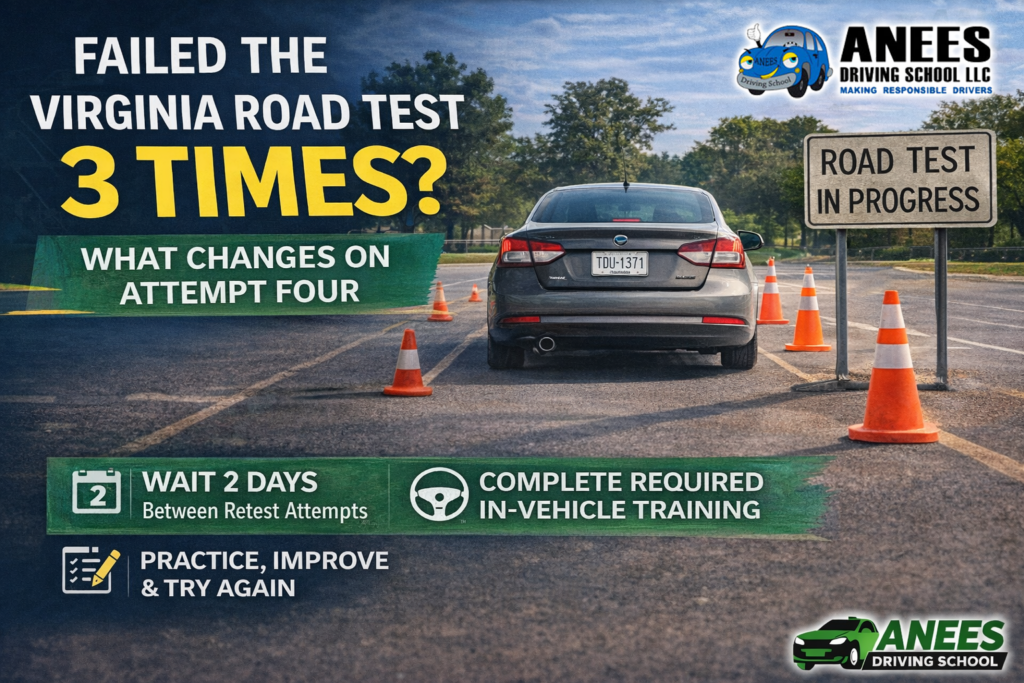
Introduction
Failing the road test three times can hit harder than failing a written test because the student has already spent time behind the wheel, practiced, and likely imagined being finished. By the third failure, frustration turns into self-doubt very quickly.
But repeated road test failures usually do not mean a student cannot become a safe driver. More often, they reveal a pattern that has not been corrected yet.
Why the same mistakes keep repeating
Most repeated failures come from one of two problems. Either the student keeps making the same technical mistakes, or the student becomes so anxious during the test that ordinary skills fall apart under pressure.
Both problems can be fixed, but not by repeating the same routine. A student who failed three times needs focused correction, not just more random driving hours.
Find the real pattern first
Before the next attempt, the student should identify the actual pattern. Was it observation at intersections? Rolling stops? Speed control? Nervous lane changes? Parking under pressure? If the family cannot name the main weak point, preparation will stay too general.
This is why honest review matters. Students improve faster when they know exactly what keeps costing them the test instead of saying they were just unlucky.
Practice has to become more specific
After three failures, broad practice is not enough. A student should work on the exact situations that keep going wrong. If lane changes are weak, then focused lane-change work matters more than another easy neighborhood drive. If nerves are the issue, then practice should include test-like conditions instead of only relaxed familiar routes.
The best preparation at this stage is targeted repetition with correction. It is better to fix one stubborn weakness properly than to do many casual drives that avoid the real problem.
Why a professional lesson often changes everything
Families often miss patterns that an instructor notices quickly. A professional can usually see whether the problem is skill, timing, confidence, observation, or test behavior. That outside perspective becomes especially valuable after multiple failures.
A final lesson before the next attempt also helps students shift mentally. They stop seeing the test as a personal judgment and start seeing it as a series of habits they can improve.
Do not let the fourth attempt feel heavier than it should
The danger of a fourth attempt is emotional overload. Students begin driving as if every second is a chance to fail, which makes them stiff and unnatural. That mindset creates new mistakes.
A better approach is to enter the next attempt with a simpler focus: observe clearly, stay calm, and drive the way you practiced. The student does not need perfection. The student needs safe, consistent decisions.
Final thoughts
Failing three road tests is frustrating, but it is also useful if it pushes the student to prepare more intelligently. Once the real pattern is identified and corrected, progress often becomes much faster.
The next attempt should not be built on panic. It should be built on specific correction, calmer practice, and stronger habits.
FAQ
What should I do first after failing three times?
Figure out the exact pattern behind the failures instead of doing more random practice.
Is more driving time always the answer?
Not by itself. Focused correction matters more than just adding hours without direction.
Can anxiety alone cause repeated road test failure?
Yes. Some students know the skills but lose consistency under test pressure.
Would a professional lesson help after repeated failures?
Often yes, because an instructor can spot patterns families miss and make practice more specific.