

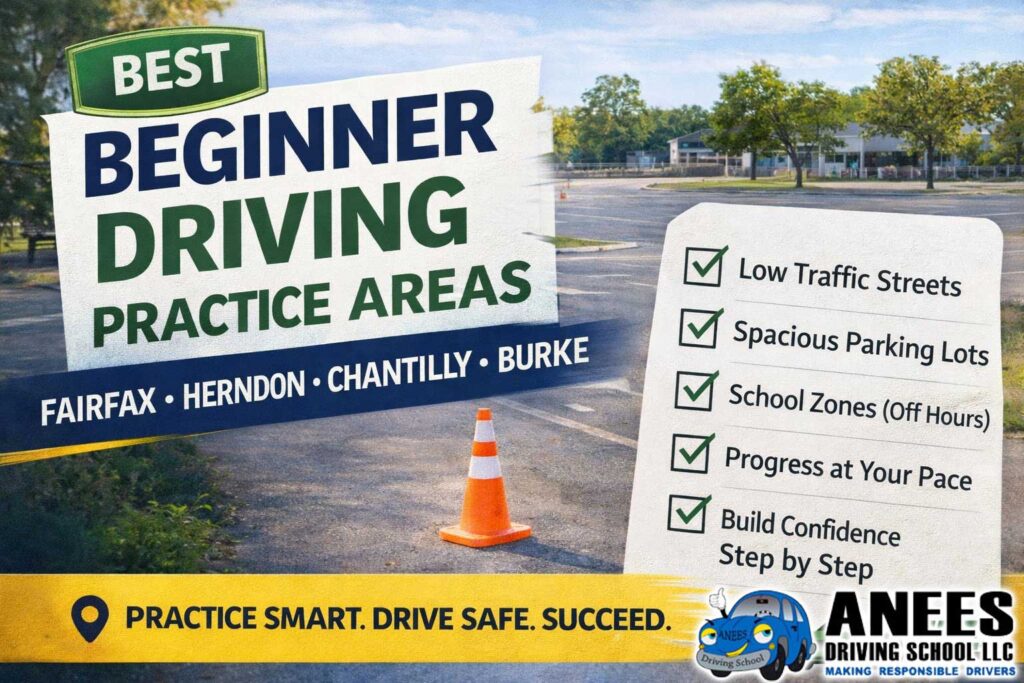
One of the biggest early challenges for new drivers is not the steering wheel. It is the question of where to practice. Families want a place that feels calm enough for a beginner but realistic enough to build actual skill.
That is especially true in Northern Virginia, where traffic can feel intimidating fast. The best practice areas are not always famous locations. They are the kinds of environments that let a beginner build confidence gradually.
What makes a practice area beginner-friendly
A good beginner practice area gives the student room to think. That usually means lower traffic, simpler turns, clear visibility, and fewer surprises. Large empty spaces are useful at first, but students eventually need gentle real-world roads too.
The goal is not to keep the student in the easiest environment forever. It is to create a progression from wide, forgiving spaces into lightly traveled roads and then into more realistic traffic situations.
How families should think about Fairfax and nearby areas
In places like Fairfax, Herndon, Chantilly, and Burke, families do better when they focus on categories of locations rather than chasing a single perfect spot. Quiet residential streets, office areas during off-hours, wide parking lots when legally available, and calmer connector roads often work better than crowded commercial zones.
That approach is safer and more flexible. It lets the family adapt based on the student’s level, the time of day, and current traffic conditions.
The best order for practice
Beginners usually improve faster when practice starts with basics like steering control, stopping, backing up, parking, and scanning in a low-pressure area. After that, the student should move into lightly traveled neighborhood roads, then busier local routes, then more complex situations.
This order matters because students build confidence when the difficulty increases in a controlled way. Throwing a beginner into a heavy traffic area too soon often creates fear instead of growth.
What families often get wrong
A common mistake is practicing only in places that feel comfortable to the parent instead of places that match the student’s skill level. Another mistake is using the same exact practice area every time. Students may become comfortable there without actually learning to adapt.
The stronger approach is variation with intention. Keep the environment manageable, but gradually introduce new road layouts, different parking situations, and slightly more demanding traffic.
When to stop self-practice and get help
There is a point where self-practice stops being enough. If the student is freezing in traffic, repeating the same mistakes, or struggling with lane changes, turns, or parking, a professional lesson often helps more than more random practice.
An instructor can choose the right kind of route, build the next skill step, and keep the student from reinforcing bad habits in the wrong environment.
Final thoughts
The best beginner practice area is not the fanciest or emptiest place. It is the environment that matches the student’s current level and supports steady growth.
Families in Fairfax, Herndon, Chantilly, and Burke can make practice much more effective by choosing calmer spaces first, then building toward real traffic step by step.
FAQ
What type of place is best for a first practice drive?
A wide, low-pressure area with minimal traffic and room for simple steering, braking, and parking practice.
Should beginners always stay in parking lots?
No. Parking lots help at first, but students eventually need lightly traveled roads and then more realistic traffic conditions.
Why should practice areas change over time?
Because students need to learn how to adapt, not just get comfortable in one familiar location.
When is it time to book a lesson?
When self-practice stops producing improvement or the student keeps repeating the same mistakes under pressure.